
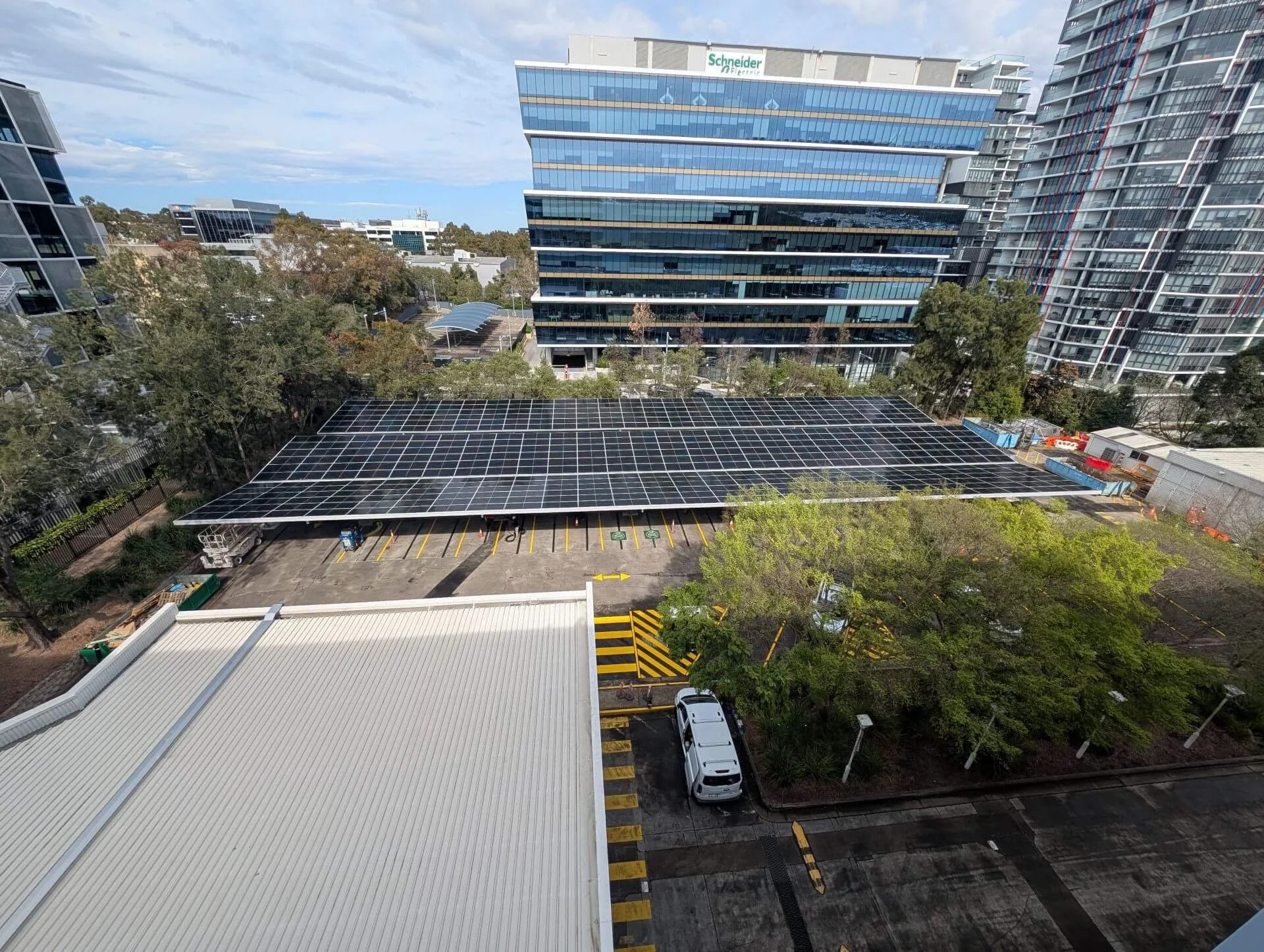
PROJECTS / ASTRAZENECA SOLAR CANOPY & EVC HUB
ASTRAZENECA SOLAR CANOPY & EVC HUB
A 300 kWp premium solar canopy with integrated EV charging — delivered in five weeks during one of the wettest Augusts on record, and 3× faster than the previous in-situ system on the same campus.
LocationSydney, NSW
CompletionAugust 2025
ClientAstraZeneca
DELIVERY PARTNER63
Pods5
WEEKS iNSTALL75
Car Spaces300 kWp
Solar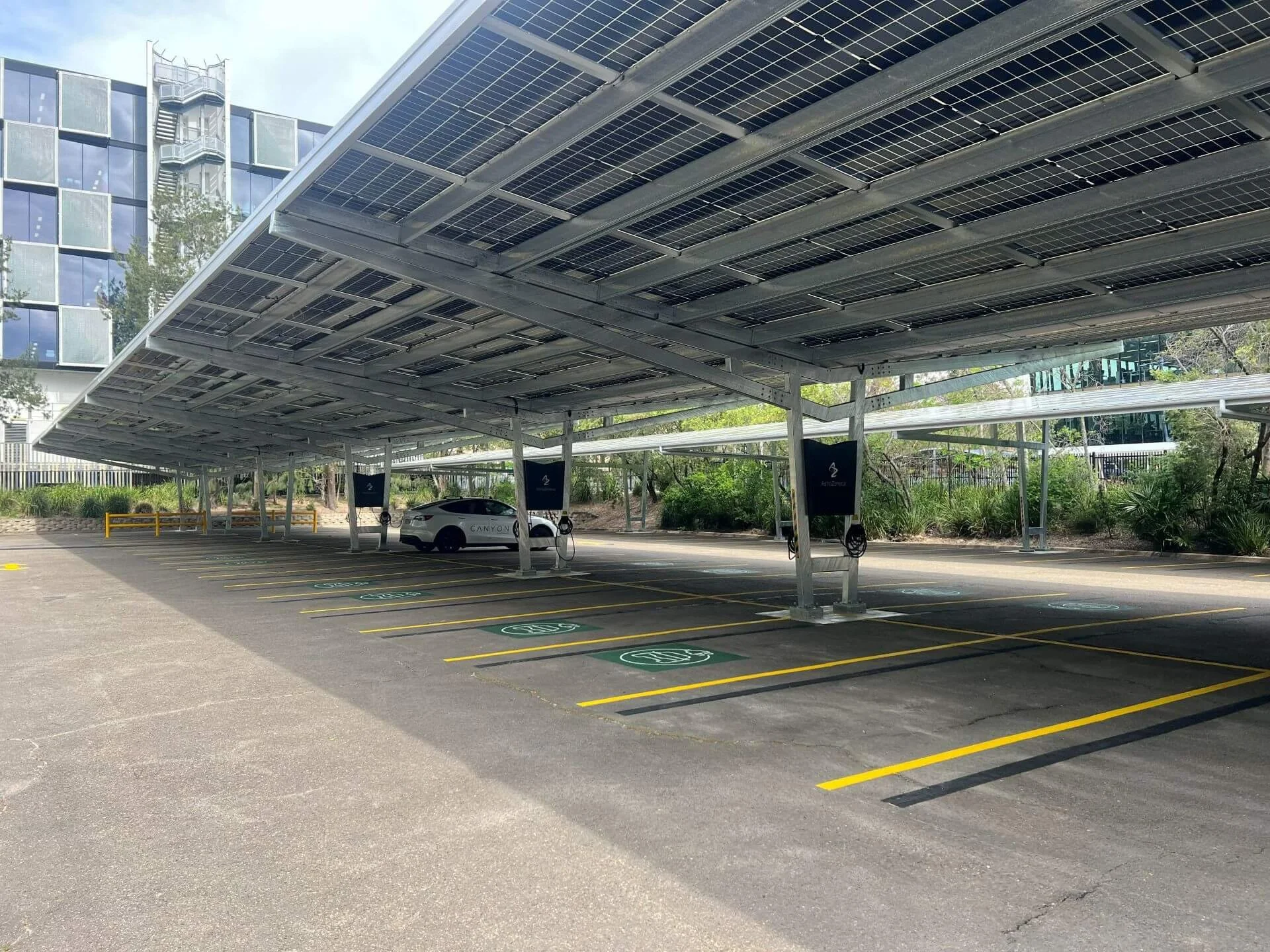
Executive Summary3× FASTER THAN IN-SITU. ON THE SAME CAMPUS. SAME CLIENT.
In partnership with Smart Commercial Energy, Canyon Solar delivered a premium 300 kWp solar canopy and electric vehicle charging hub for AstraZeneca, one of the world's leading pharmaceutical companies. The project was executed within a tightly compressed five-week window to minimise disruption to operations — despite construction during one of the wettest Augusts on record.
AstraZeneca is one of the only companies to have installed both an in-situ and a prefabricated solar car park, providing a direct, real-world comparison between standard "stick-built" construction and Canyon Solar's patented modular solar canopy methodology.
3× faster installation than the previous in-situ system of comparable size
Less than 25% of the on-site installation hours, reducing cost and high-risk work
A fully waterproof system that has become the most sought-after parking on campus
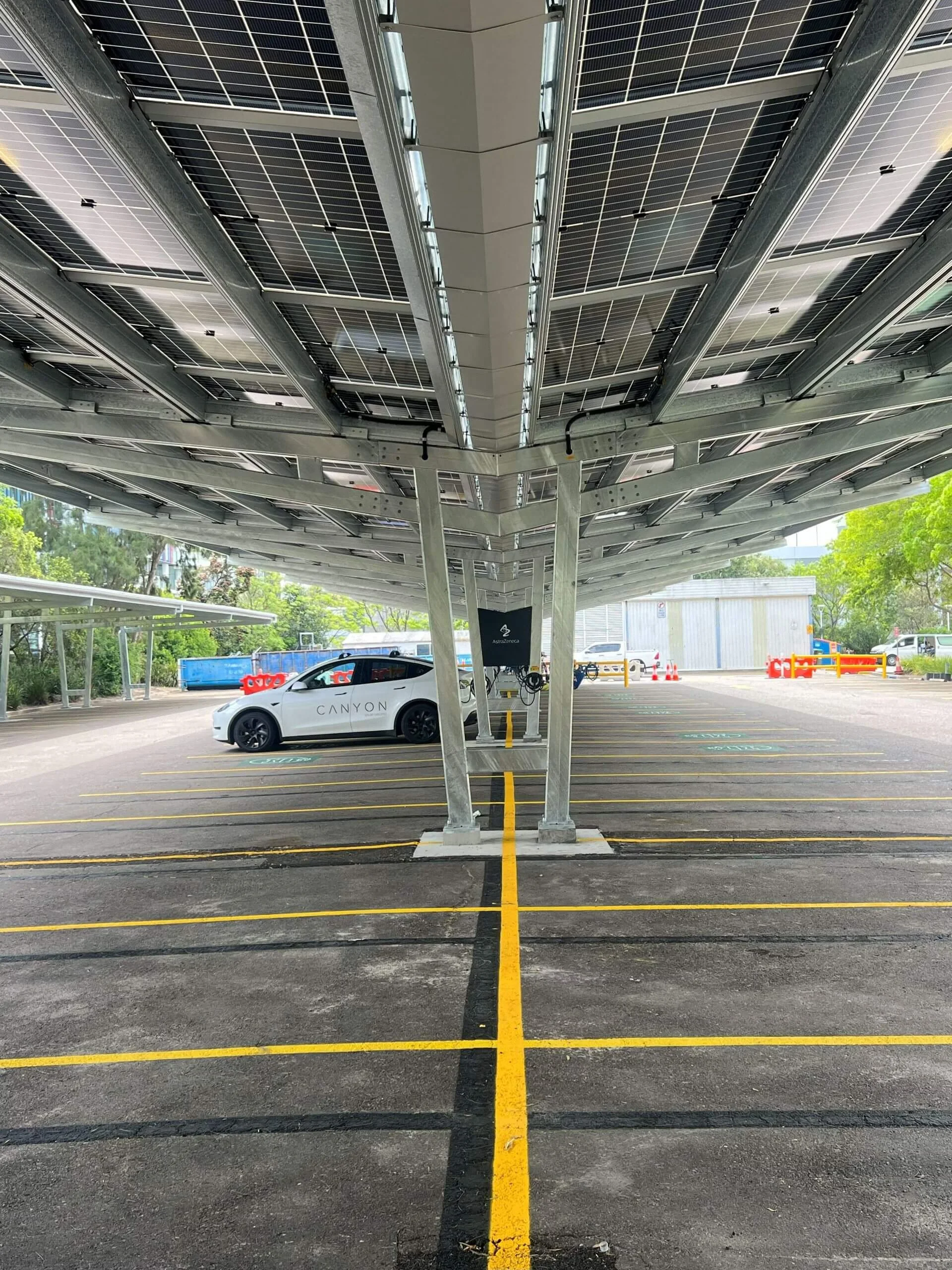
EV CHARGING, DESIGNED FOR FLEXIBLE
The Operational DilemmaINFRASTRUCTURE VS. CONTINUITY.
For large-scale commercial facilities, infrastructure upgrades must be carefully designed and managed to minimise disruption to operations. Parking is a particularly critical logistical asset — the daily entry point for hundreds of employees, a staging area for deliveries, and a key component of site traffic management.
Traditional solar carpark construction (often called "stick-built" or "in-situ") involves constructing each element on site — panel by panel, purlin by purlin. This results in:
Extended disruption — typical in-situ solar carpark installations take several months
Safety and quality risk — over 75% of on-site man-hours involve high-risk work, including working at height
Design continuity gaps — most in-situ systems bolt together off-the-shelf components, with features like waterproofing, lighting and EV charging treated as poorly integrated extras
AstraZeneca required a solution that would deliver a high-yield renewable energy asset with EV charging without compromising the safety or efficiency of an active corporate campus. The objective was clear: significant energy outcomes with minimal operational friction.
The Strategic ShiftPREFABRICATION FIRST.
80% OFF-SITE.
Across construction — from housing to utility-scale renewables — prefabrication is now the gold standard of advanced delivery. Faster installs. Lower site risk. Higher quality control. Greater cost certainty. For solar car parks, the benefit is amplified: the car park becomes operational sooner, protecting staff access, customer experience and revenue. With over 40% of solar car park costs tied to on-site labour, shifting work into a controlled factory environment delivers immediate economic and safety advantages.
For AstraZeneca, Canyon Solar reversed the traditional labour model. Modular pods — inclusive of module racking and wiring — were fully assembled off-site in controlled factory conditions. With 80% of the canopy manufactured off-site, the remaining 20% was limited to civil works (foundations) and assembly on site. The benefits of this approach were highlighted when the installation window coincided with record-breaking rainfall — conditions that would typically stall traditional methodologies for weeks or months, leaving the client with a fenced-off, muddy car park and no power generation.
TECHNICAL DEEP DIVEENGINNERING A PREMIUM ASSET.
Speed of delivery is meaningless if the final asset does not meet the highest technical standards. The AstraZeneca solar car park was designed as a flagship sustainability asset, combining next-generation generation technology with user-centric design.
1. HIGH-YIELD GENERATION (AIKO ENERGY PANELS)
To maximise the energy density of the limited car park footprint, we deployed AIKO Energy solar panels in our unique high-efficiency layout. These units use All-Back-Contact (ABC) technology, eliminating grid lines on the front of the cell and leading the market in conversion efficiency — ensuring AstraZeneca generates maximum kWh per square metre of canopy. Our 'triple pod' system extends the canopy beyond the bounds of the car space, providing more area for both generation and shading.
2. INTERGRATED MOBILITY HUB
The structure serves a dual purpose as a renewable energy asset and a fuel station for the future. Six 22 kW AC EV chargers are integrated directly into the canopy columns. Thanks to the prefabrication process, cabling routes were pre-planned and concealed within the structure — no unsightly retrofitted conduit, no external cabling, a clean waterproof finish. A bespoke EV cable management system, developed in-house by the Canyon team, meets AstraZeneca's strict EHS requirements by preventing cables being left on the ground.
3. WATERPROOF AMENITY
Unlike standard solar shade structures which may drip or leak between panels, the Canyon Solar system features a fully waterproof canopy roof design. This transforms the car park into a premium employee amenity, offering genuine all-weather protection for staff and vehicles alike.
"On Monday morning the car park was open sky. By Tuesday afternoon it was a sea of solar."
The 48-hour pod install — 63 pods, single 60-tonne craneLogisticsTHE 48-HOUR TRANSFORMATION.
The climax of every Canyon Solar project is the pod installation phase. At AstraZeneca, this 48-hour window vividly illustrated the difference between traditional construction and modular installation. Using a 60-tonne mobile crane, the installation team lifted 63 fully assembled pods into position in just two days — the fastest pod installation sequence in Canyon Solar's history using a single crane configuration. To the client and their staff, the transformation was almost instantaneous.
Project OutcomesTHETHE COMPARATIVE VERDICT.
AstraZeneca’s unique position, having commissioned both a traditional solar carpark build (2023) and a Canyon Solar solar canopy build (2025), provided a rare, data-driven comparison of the two methodologies.
Speed of Delivery
(3x Improvement)
The project moved from site establishment to commissioning in just 5 weeks. The client confirmed this was more than three times faster than their experience with the previous in-situ installation.
Operational Continuity
The “super fast install” was explicitly cited by the client as having minimised impact on their operations. By reducing the time on site, we reduced the impact on the people who work there.
Safety & Quality Compliance
For a pharmaceutical giant, safety is non-negotiable. The Canyon Solar process met the rigorous standards required for an operational AZ site, largely achieved by completing 80% of the work in the safety of our factory.
CONCLUSIONUPGRADE YOUR INFRASTRUCTURE
WITHOUT DOWNGRADING YOUR OPERATIONS.
The AstraZeneca project stands as a proof-of-concept for the future of commercial solar car park infrastructure. It demonstrates that the transition to renewable energy does not require a sacrifice of operational capacity. By standardising 80% off-site prefabrication, Canyon Solar removes the variables that plague traditional construction — weather, site congestion and safety risk — delivering premium energy assets with a level of certainty that the old way of building simply cannot match.
IS YOUR FACILITY READY FOR INFRASTUCTURE THAT WORKS AROUND YOU?
Contact the Canyon Solar team today to get a proposal for your site.